What is Contemporary Sculpture? Contemporary Sculpture is a sculpture art that emerged after the 1960s with “conceptual priority”, ‘experimentation’ and “multi-media fusion” as its core. It breaks the limitation of the traditional sculpture techniques of “carving, engraving, and molding”, and turns to “stacking, winding, planting, and programming” to transform ‘material’ into “language for expressing concepts”. “the language of expressing concepts”.
Simply put, the logic of contemporary sculpture is: “I want to tell a story → find the most suitable material → present it in the most special way”, rather than “I can carve a stone → find a theme to carve”.
Differences from traditional sculpture
See the core differences in one table:
| Dimensions | Traditional Sculpture | Contemporary Sculpture |
| Expression | Figurative (figures, animals), monumental | Abstract, interactive, conceptual |
| Functions | Aesthetic, monumental (e.g. statues of celebrities) | Issue awareness, social intervention (e.g. environmental, gender) |
| Viewer Role | Passive viewing (standing in front of the sculpture and looking at it) | Active participation (touching, interacting, taking pictures) |
| Material | Stone, wood, metal (fixed, heavy) | Everything (plastic, ice, light, AI) |
Stages in the development of contemporary sculpture
The evolution of contemporary sculpture is essentially a “constant expansion of artistic boundaries”:
- 1960s Minimalism: artists use simple geometric shapes (e.g., cubes, cylinders) and emphasize “the properties of the material itself” (e.g., the luster of metal, the texture of stone), represented by Donald Judd .
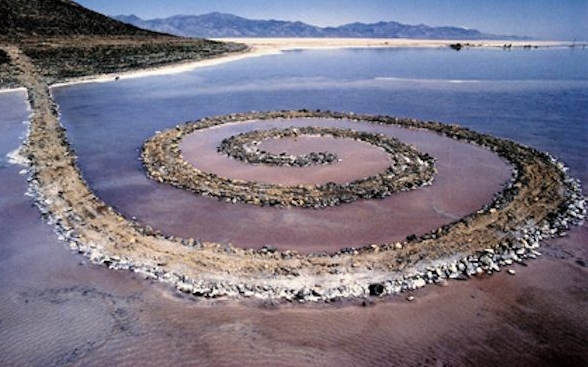
- 1970s Groundscape Art: sculpture is “moved outdoors” and combined with the natural environment (e.g., giant circles piled up with stones), representative figure: Robert Smithson.
- 1980-1990s Installation and Performance: Sculpture is no longer a “static object” but a “spatial installation” (e.g. wrapping an entire room with rope) or a “performance” ( e.g. the artist lives in the sculpture), represented by Joseph Beuys.
- 2000s – present Digital and Crossover: 3D printing, AI, VR and other technologies are used to make sculptures “move” and “come alive” (e.g. dynamic sculptures generated by AI), represented by Anish Kapoor and Yayoi Kusama. Kusama.
Typical Characteristics of Contemporary Sculpture
The charm of contemporary sculpture lies in the fact that it constantly breaks the “impossibility”, and the following four characteristics can best reflect its “revolutionary”:
Multi-Media and Material Revolution
The materials of traditional sculpture are “fixed” (stone, wood, metal), while the materials of contemporary sculpture are “open” – as long as the idea can be expressed, anything can be used:
- Natural materials: plants ( e.g. sculptures grown from succulents), ice (e.g. the “Ice Sculpture Festival” in Scandinavia), stone (but instead of carving it, it is piled up into giant structures);
- Industrial materials: plastic (e.g. giant whales made out of recycled plastic bottles), metal (e.g. mirrored sculptures made out of stainless steel), fiberglass (e.g. lightweight abstract shapes);
- Digital materials: light (e.g. dynamic sculptures made of LEDs), sound (e.g. sculptures that make music), AI (e.g. sculptural shapes generated by algorithms).
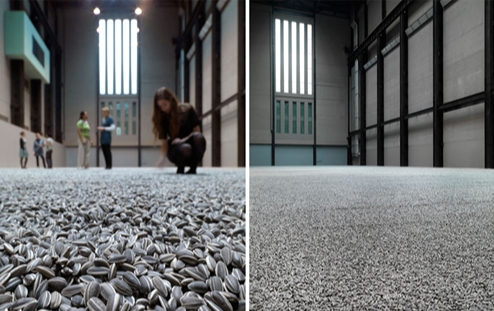
Example: Ai Weiwei’s Sunflower Seeds paves the earth with 100 million ceramic seeds, each hand-painted to represent “the relationship between the individual and the collective”-seemingly identical seeds, but in fact each one is unique.
Conceptual Priority: “Sculpture is a carrier of ideas”
Contemporary sculpture no longer pursues “beauty” but “meaning”. Through their works, artists discuss social issues (e.g., race, gender, environmental protection), philosophical questions (e.g., “what is existence”), and technological reflections (e.g., the relationship between AI and humans).
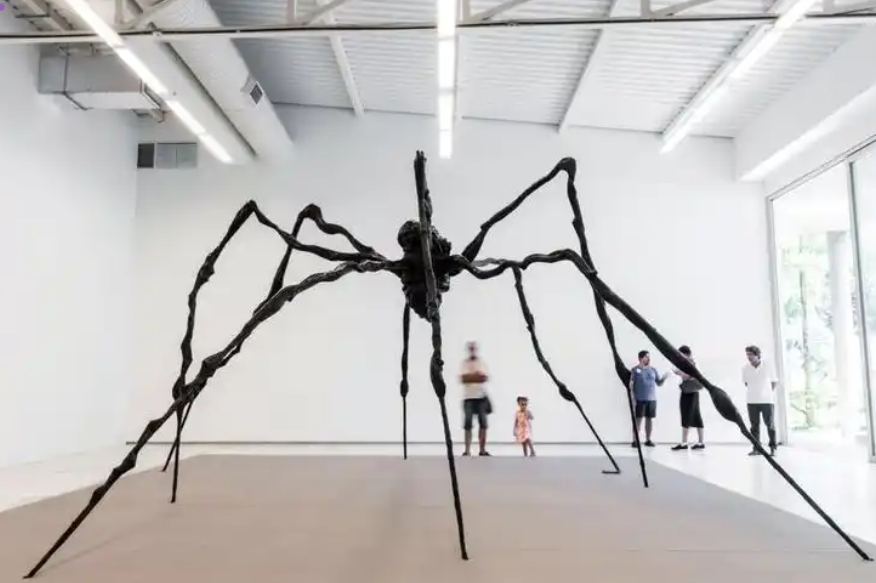
Example: Louise Bourgeois’s “Spider” uses textile fibers to make a spider with human-like legs to symbolize “motherly protection and oppression”-the spider is “the guardian of the web,” but also Spiders are “guardians of their webs” but also “bind their prey”, provoking thoughts about the “role of women”.
Redefining Space and Experientiality
Traditional sculpture is “put there for you to see”, contemporary sculpture is “inviting you to participate”. It emphasizes “spatial intervention,” allowing the viewer to become part of the work by touching, photographing, and interacting with it.
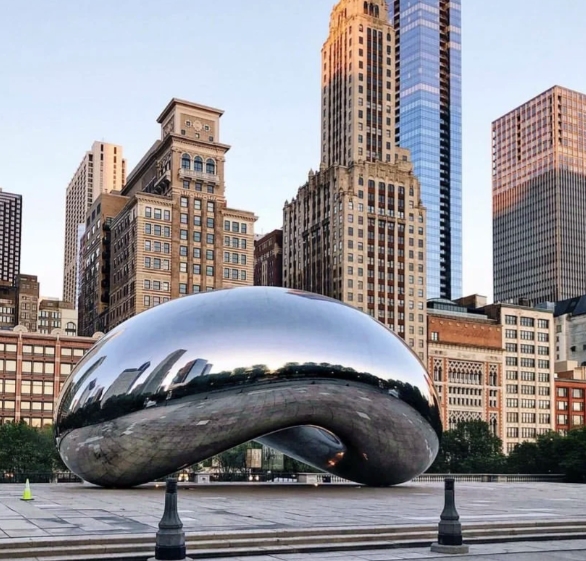
Example: Anish Kapoor’s Cloud Gate (Millennium Park, Chicago) is a huge mirrored stainless steel sculpture that resembles “the city’s ha-ha mirror” – viewers can stand underneath, see their own distorted reflection, and even take photos and share them, becoming the “creators of the work.”
Formal fluidity and cross-border mixing
Contemporary sculpture is no longer a “single art form”, but blends with architecture, dance, theater, AI, VR and other fields:
- Sculpture + Architecture: e.g. “inhabitable sculptures” (sculptures that look like houses) made from metal structures;
- Sculpture + AI: e.g. “dynamic sculptures” generated with algorithms (shapes that change over time);
- Sculpture + VR: e.g. “Immersive Sculpture” (using VR glasses to see the virtual sculpture as if you could touch it).
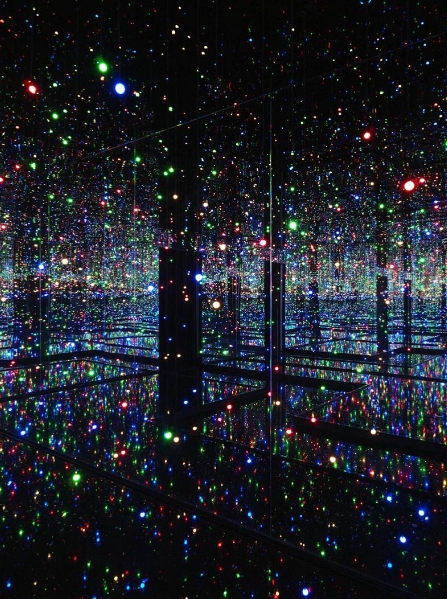
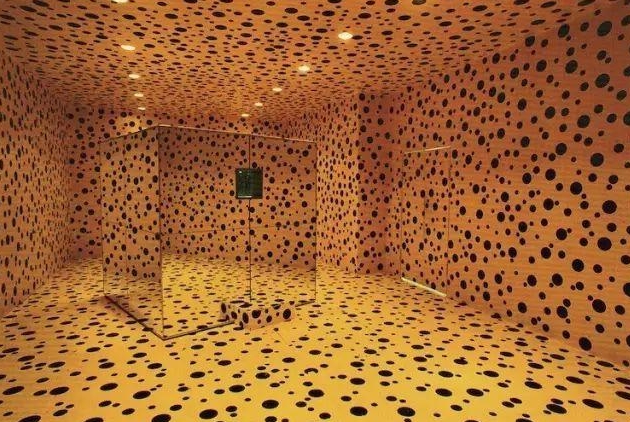
Example: Yayoi Kusama’s “Mirror House” (a globally traveling exhibition) is a fully mirrored room filled with glowing polka dots, and the viewer will feel that “he or she is integrated into an infinite space” when they go in – a hybrid of “sculpture + installation + VR”.
Main Types of Contemporary Sculpture
There are many “subdivided types” of contemporary sculpture, the following are the five most common:
Installation Sculpture
Definition: Using a variety of materials to combine into a “spatial installation”, emphasizing “the relationship between the environment and the work”;
Examples: Yayoi Kusama’s House of Mirrors, Ai Weiwei’s Sunflower Seeds.
Conceptual Sculpture
Definition: “Concepts take precedence” and materials are merely “tools for expressing concepts”;
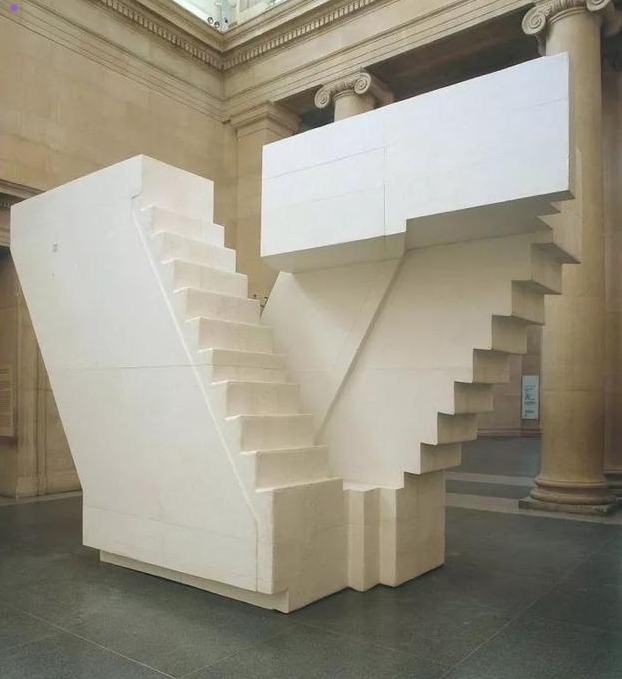
Example: Rachel Whiteread’s House (using concrete to pour the “negative space” of a house “, i.e. the ‘silhouette’ of the house), exploring ”existence and disappearance”.
Behavioral Sculpture
Definition: In conjunction with “performance art,” the artist “brings the sculpture to life” through “movement;”
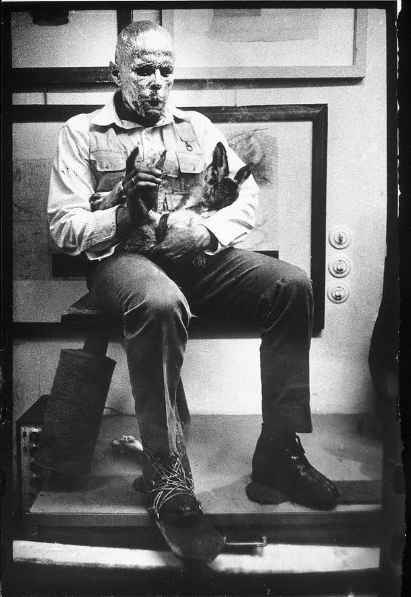
Example: Joseph Beuys’ “How to Explain Painting to a Dead Rabbit” ( The artist holds a dead rabbit, walks around the gallery and puts the rabbit on the sculpture), which explores “art and communication”.
Landscape Sculpture
DEFINITION: Integration with the natural environment, “blending in” rather than “occupying” the environment;
EXAMPLE: Robert Smithson’s Spiral Dike (a spiral structure made of stones piled on top of each other, located in Salt Lake, Utah) creates a “a dialog with nature.”
Digital Sculpture
Definition: sculptures made with digital technologies (3D printing, AI, VR);
Examples: “customized sculptures” made with 3D printing (e.g., sculptures printed based on your face), “dynamic sculptures” generated with AI (shape changes over time).
Contemporary Sculpture in Public Space and Everyday Scenes
The future of contemporary sculpture must be “technology-driven.” Here are a few key trends:
3D printing and programmable materials
3D printing: can quickly produce “complex shapes” (such as hollowed-out metal sculptures), and even ‘customization’ (such as sculptures printed according to your body);
Programmable materials: such as “shape memory alloys “ (that change shape with temperature), ”smart plastics” (that change color with light) to make the sculpture “move”.
AI algorithms generate sculptures
AI algorithms are used to “learn” an artist’s style and generate “new sculptures” (e.g., abstract sculptures generated by GAN algorithms);
or even “AI + human” collaboration: Even “AI + human” collaborations: the artist comes up with the idea, the AI generates the shape, and then 3D prints it.
Deformable and dynamic sculptures
Dynamic sculptures“ made with mechanical devices (e.g., sculptures that ‘bloom’ like flowers);
Interactive sculptures” made with sensors (e.g., sculptures that change shape in response to the audience’s voice). (e.g., a sculpture that changes shape in response to the audience’s voice).
AR/VR Immersive Sculpture
Seeing “virtual sculptures” with VR glasses (e.g., seeing “disappearing sculptures” in a museum with VR);
Using AR technology to make “virtual sculptures” appear in reality (e.g., pointing a cell phone at the sky and seeing “virtual sculptures”). Use cell phone to the sky, see “floating sculpture”).
Frequently Asked Questions FAQ: Everything you want to know!
What materials can be used for contemporary sculpture?
A: Everything! Plastic, ice, light, AI, recycled garbage can all be used for sculpture as long as they can express an idea.
Why are many contemporary sculptures “unreadable”?
A: Contemporary sculpture emphasizes concept rather than form. For example, Ai Weiwei’s Sunflower Seeds, if you don’t know the concept of “each seed is unique”, you will think that it is “just a bunch of ceramic seeds”. To understand contemporary sculpture, one needs to “understand the context” (e.g., the artist’s intention, social issues).
Can Contemporary sculpture be displayed at home or in the garden?
A: Yes, it can! For example, small installation sculptures (e.g., abstract shapes made of glass), digital sculptures (e.g., small ornaments made with 3D printing), and geoscopic sculptures (e.g., small circles made of stones) can be placed at home or in the garden.
How does an artist define the “boundaries” of a sculpture?
A: There are no “fixed boundaries” for contemporary sculpture! As long as it conforms to the idea that “sculpture is three-dimensional or spatial art” (e.g., occupies space, has volume), it can be called sculpture. For example, “House of Mirrors” is a spatial installation, which is also a sculpture; “Dynamic Sculpture” is a mechanical installation, which is also a sculpture.
What is the difference between Contemporary Sculpture and Installation Art and Performance Art?
A: Contemporary sculpture: emphasizes “three-dimensional or spatial” (e.g., a shape that occupies a space);
Installation art: emphasizes “the relationship between the environment and the work” (e.g., filling an entire room with materials);
Performance art: emphasizes “movement and time” (e.g. an artist’s performance).
However, the three often “cross-border”, for example, “behavioral sculpture” is a hybrid of “behavior + sculpture”.
Contemporary sculpture is not just an object “sitting there”, it is a way of asking questions about the world. It is a way of asking questions about the world. It dares to challenge tradition, is good at integrating science and technology, and is capable of touching emotions as well as facilitating dialogues. Whether you are a viewer, a designer or a collector, you will be inspired by its diversity.