The Terracotta Warriors, hailed as the “underground army that has slept for two thousand years,” are not only a symbol of the Qin Empire’s authority but also the pinnacle of ancient Chinese terracotta sculpture craftsmanship. With the popularization of ceramic art education and the cultural revival movement, an increasing number of art enthusiasts aspire to recreate this historical masterpiece with their own hands.
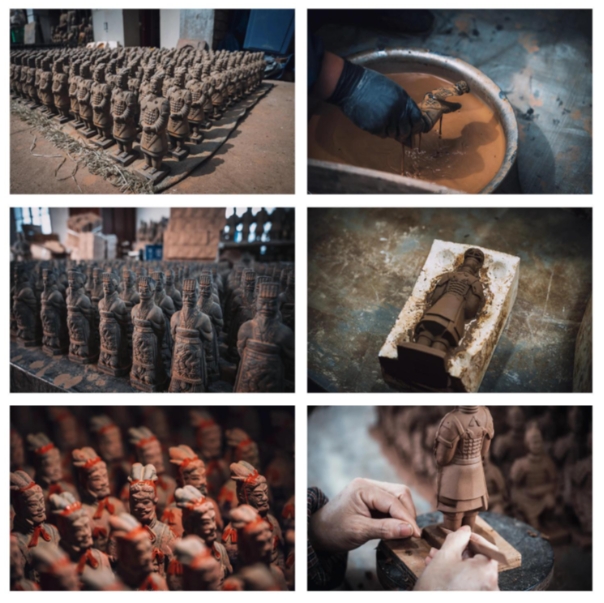
How to create Terracotta Warrior sculptures? This guide will take you through the modern restoration process of Terracotta Warrior sculptures, from selecting clay, shaping, and assembling, to drying, firing, and painting. It not only focuses on modern ceramic art techniques but also incorporates key details extracted from archaeological research (such as sand-tempered clay, modular structures, and gray slip painting), helping you achieve both formal and spiritual restoration in your creations.
Clay Selection and Basic Tools
Recommended clays: red clay, sand-tempered clay, composite mixture of imitation Qin clay (can be adjusted)
Archaeological inspiration: [1] The terracotta warriors themselves use sand-tempered clay with a high sand content, which helps with the firing and carving performance of large terracotta figures.
Tools to prepare:
Pottery knife, sculpting pen, scraper, turntable, sponge
Wooden auxiliary molds (e.g., leg structure molds), clay mixing cup
Clay Mixing Recommendations:
If using custom-mixed clay, add approximately 30% fine sand to enhance firing strength and structural support.
Practical Recommendations: Beginners are advised to start with busts or half-body Terracotta Warriors, with dimensions between 30–50 cm, to facilitate mastering proportions and structural stability.

Detailed Sculpting Steps: Structural Decomposition + Archaeological Insights
Torso and Leg Structure
- Use a separate hollow cylinder construction method, either the coiling method or the slab method.
- Structural reference: Qin terracotta warriors generally have a stable lower body, with skirts and armor that are neither too tight nor too loose, and a straight or semi-sideways posture when viewed from the front.
Head Construction (Integration of Archaeology and Art)
- The face is sculpted separately, shaping the nasal bridge, cheekbones, beard, and expressive eyes.
- Reference: Terracotta warriors often feature hair buns, hats, and hair strand details, with intricate carvings showcasing artistic skill.
- Design choices can be inspired by archaeological typology classifications such as warrior figurines, kneeling archer figurines, and general figurines.
Limb Connection and Dynamic Expression
- The upper arm and forearm should be connected in segments to retain joint flexibility
- Hand movements can mimic classic Terracotta Warrior poses such as holding a halberd, clenching a fist, or crossing arms
Assembly and structural integration
- Use mud slurry as an adhesive, combined with mud strips to reinforce the structural integrity of the seams
- During the early drying phase, wrap the seam areas with a damp cloth to prevent cracking
Historical craftsmanship comparison: [2] Terracotta warriors employ a “non-modular disassembly method,” with each figure independently shaped and partially assembled, differing from later mass-production mold techniques and more closely resembling contemporary individual ceramic art creation.
Drying and Firing Techniques (Combining Modern Technology with Ancient Principles)
Drying Control
Mainly natural air drying, with a cycle of approximately 7–14 days, depending on size and humidity.
Store in a cool, shaded area away from wind. Cover with a damp cloth initially to prevent cracking.
Firing Method Comparison
Electric Kiln Method:
- Recommended stepwise temperature increase (200°C per hour), with a final temperature of 950–1050°C
- Insulation phase of at least 1 hour
Wood-Fired Kiln Simulation:
- Traditional dragon kilns or vertical kilns can be used to simulate an oxidizing atmosphere
- Pay attention to chimney draft, firehole position, and ventilation hole arrangement
Ancient Insights:
- [3] Analysis of Qin Terracotta Warrior fragments revealed firing temperature differences as high as 260°C, suggesting artisans may have combined open-air firing with smoke kilns to address stress variations in large structures
- The logic of multi-batch, multi-workshop parallel production inspired modern ceramics courses to adopt team-based division of labor approaches
Painting Techniques and Antique Finishing: Recreating the Beauty of Gray Plaster Paintings
Base Layer Treatment
Mix white stone powder and glue to form gray plaster, then apply it to the surface after firing to imitate the original gray plaster layer of the terracotta warriors.
Painting Method
Recommended Materials:
- Acrylic paint + water dilution
- Traditional mineral pigments (such as cinnabar, malachite, ochre) + gelatin solution
Recommended Order: Base coat > Main color tone > Auxiliary color lines > Aging and blurring
Antique Finishing Techniques
- Wiping method: While the paint is still damp, use a damp cloth to partially remove it, creating an aged appearance.
- Smoking method: Gently smoke the painted areas with incense or wood shavings to enhance the historical flavor.
Protective Treatment
- It is recommended to apply a layer of matte transparent protective coating at the end to enhance moisture resistance and crack resistance
Archaeological reference: [4] The painted terracotta warriors unearthed have mostly oxidized and peeled off, but their original colors were once extremely vibrant (cinnabar red, turquoise, purple, etc.). Modern creations can appropriately retain their expressiveness and color reproduction.
Historical Craftsmanship Insights and Dialogue with Modern Ceramic Art
Non-modular Individualized Creation
Although the Terracotta Warriors were mass-produced, no two are alike, each featuring individual sculptural forms and distinctive details, embodying the concept of individualized aesthetics.
Material and Structural Responsiveness
Ancient sand-tempered pottery enhanced firing stability; modern creations can incorporate similar particle ratios.
Hollow cylindrical structures combined with reinforced bases enhance the structural integrity of large-scale sculptures.
Connecting Terracotta Warriors with Contemporary Installation Art
The Terracotta Warriors exemplify collective order, role arrangement, and spatial presence. Contemporary art can similarly explore the relationships between the individual and the collective, as well as between commemoration and narrative.
Frequently Asked Questions (FAQ)
Q1: How can I prevent sculptures from cracking during firing?
A: Ensure that hollow structures are free of trapped gases, thoroughly dry, and heated gradually.
Q2: Can I skip firing and air-dry the clay instead?
A: Air-drying clay is possible, but the texture and strength will be inferior, making it unsuitable for long-term preservation or achieving an antique finish.
Q3: How can I achieve a clay color similar to that of the Terracotta Warriors?
A: Add red clay powder or iron oxide powder to acrylic paint to simulate the texture of fired clay, then use brush strokes or wiping techniques to age the surface.
Q4: Can I create female Terracotta Warriors?
A: Of course! Combining historical elements with modern imagination,
When you knead a lump of clay in your hands, trying to replicate the movements of the Terracotta Warriors, you are participating in more than just a sculptural creation—you are engaging in the transmission and reenactment of cultural memory. From imitation to innovation, from craftsmanship to spirit, every stroke and every line is a transcendent dialogue with the artisans of two thousand years ago.
What you have created is not merely a sculpture of the Terracotta Warriors, but the shape of history continuing in the palm of your hand.
References:
- Terracotta Production Techniques – The Getty [https://www.getty.edu/publications/terracottas/production_techniques/]
- GuessWatches – How to Make Terracotta Sculpture [https://services.guesswatches.com/how-to-make-terracotta-sculpture-2/]
- iKaiAsai Blog – Terracotta Pottery [https://ikaiasai.com/en-us/blogs/blogs/terracotta-pottery]
- RuralHandmade – Terracotta & How Do You [https://ruralhandmade.com/blog/a-complete-guide-to-everything-terracotta-and-how-do-you]