Terracotta Army Sculpture in China
Terracotta Army, a masterpiece of ancient art known as the “Eighth Wonder of the World”, is one of the most important discoveries in Chinese archaeology. As the burial objects in the mausoleum of the First Qin Emperor, the Terracotta Army not only demonstrates the superb ceramic art of ancient China, but also reveals the social, political, military and cultural history of the Qin Dynasty. This research report will comprehensively explore the historical background, cultural value, scientific significance, and conservation and utilization status of the Terracotta Warriors, with a view to gaining a deeper understanding of this world-class cultural heritage.
Qin Shi Huang and the discovery of the Terracotta Warriors
Qin Shi Huang
Qin Shi Huang (259 BC – 210 BC), formerly known as Ying Zheng , was the founding emperor of the Qin Dynasty, the first great unified dynasty in Chinese history. He unified the Six Kingdoms in 221 BC and established the first centralized feudal state in Chinese history. As an ambitious monarch, Qin Shi Huang not only achieved political unification, but also implemented a series of major reforms in cultural, economic and military aspects, such as the unification of writing, currency, weights and measures, etc., which had far-reaching impacts on Chinese history.
Discovery of Terracotta Warriors
The discovery of the Terracotta Warriors was fortuitous: in the spring of 1974, farmers in Xiyang Village, Lintong County, Shaanxi Province (now Lintong District, Xi’an City) dug out fragments of terracotta human heads from a depth of more than 2 meters when drilling a well for drought relief, a discovery that attracted the attention of the archaeological department. Subsequently, archaeologists rushed to the site, and after exploration and trial excavation, it was confirmed that the site was 1.5 kilometers away from the Mausoleum of the First Qin Emperor, and that a large number of life-size terracotta warriors were buried in the ground .On March 29, 1974, archaeologists officially began excavation of the area, and the Terracotta Warriors, a world-class cultural heritage, was brought back to the light.
Layout of the Mausoleum of Qin Shi Huang
The Mausoleum of Qin Shi Huang is located in Lintong District, 35 kilometers east of Xi’an City, Shaanxi Province, with a total area of 56.25 square kilometers in the mausoleum area. The archaeological remains of the mausoleum area include the underground palace and sealing soil, the inner and outer city walls, and the ground accessory buildings [10]. The Terracotta Warriors and Horses Pits are located on the east side of the Mausoleum of Qin Shihuang, and are named Pit No. 1, Pit No. 2, and Pit No. 3 according to the order of discovery, covering an area of about 20,000 square meters, and it is estimated that nearly 8,000 pieces of terracotta warriors and horses can be unearthed.
-
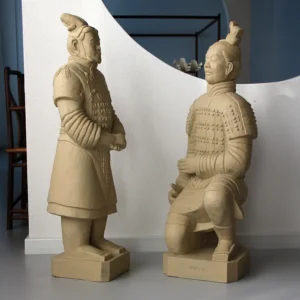
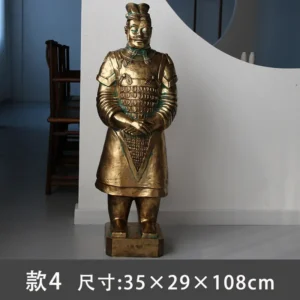 Product on saleOne-to-one Terracotta Army sculptureOriginal price was: $380.00.$360.00Current price is: $360.00.
 -
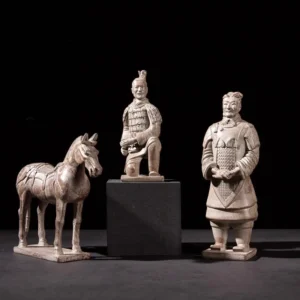
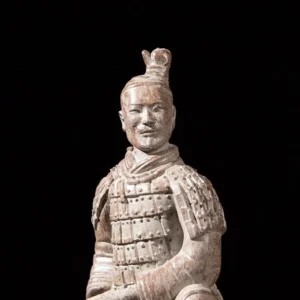 Product on saleTerracotta Army SculptureOriginal price was: $100.00.$95.00Current price is: $95.00.
Historical Background of Terracotta Warriors
Evolution from human martyrdom to terracotta warrior martyrdom
The emergence of the Terracotta Warriors originated from the ancient emperors’ emphasis on life after death and the funeral concept of “death is like life”. In the slavery society, after the death of a slave owner, slaves had to be martyred to accompany the slave owner. With the development of time, this cruel system of human martyrdom was gradually replaced by terracotta martyrdom, i.e., terracotta warriors (including terracotta warriors) were used instead of living people to be buried. The construction of the Terracotta Warriors and Horses of the Mausoleum of Qin Shihuang began in the 1st year after Qin Shihuang’s accession to the throne, 246 BC, and continued for about 38 years after Qin Shihuang’s death, the project lasted for nearly forty years and used more than 700,000 people.
Funeral concept of “death is like life”.
The construction of the Terracotta Warriors and Horses of Qin Shi Huang’s Mausoleum profoundly reflects the funeral concept of “death as life”. The ancients demanded that “treating the dead as one would treat the living is a rite of passage”, i.e., treating the dead as one would treat the living is in line with the rite of passage. This concept is particularly prominent in the Qin Dynasty, the Qin people advocate “death as life”, the Terracotta Warriors burial system may be a fusion of the pre-Qin martyrdom practices and the Qin Shi Huang’s pursuit of eternal life. The terracotta warriors replaced the burial of the living, reflecting the progress of society.
Symbolism of Terracotta Warriors
The terracotta warriors symbolize the army stationed outside the capital, which can be called the host army. These terracotta warriors and horses in strict ranks may reflect the historical scene of the Qin Dynasty when the army was organized and swept through the six countries. They not only reflect the highly centralized political system and tight military organization of the Qin Dynasty, but also symbolize the supremacy of the imperial power and the prosperity of the Qin state.
Terracotta Warriors Construction and Craftsmanship
Construction process
The construction of the Terracotta Warriors began in 246 BC, the first year after Qin Shi Huang’s accession to the throne, and continued for about 38 years after his death. The project lasted for nearly forty years and utilized more than 700,000 craftsmen [7]. Existing studies usually believe that these terracotta warriors were the garrison of Qin Shi Huang, and according to the concept of “death is like life” advocated during the Qin and Han Dynasties, perhaps these terracotta warriors in strict formation can reflect the historical scene of the Qin Dynasty when the Qin Dynasty organized its troops and swept away the six kingdoms.
Production process
Since its discovery in 1974, after nearly 50 years of excavation, restoration and research, the archaeologists of the Terracotta Warriors have made it clear that the Terracotta Warriors in the vast array of military formations were first molded using the clay bar pan construction method, and the Terracotta Warriors were completed with the help of the molding process. Terracotta Warriors production process is exquisite, reflecting the Qin Dynasty high level of pottery and plastic art.
Painting process
When the Terracotta Warriors were first unearthed, many of them retained brightly colored paintings, but these paintings quickly oxidized and fell off after coming into contact with the air. In order to protect these precious paintings, the Cultural Relics Protection Team of the Qin Shihuang Imperial Mausoleum Museum has been carrying out protection and research work on the paintings of the Terracotta Warriors. Team “terracotta warriors painted protection technology research” project in 2004 won the second prize of the National Science and Technology Progress. These researches not only protect the cultural relics, but also provide valuable experience for the protection of world cultural heritage.
Cultural Value of Terracotta Warriors
Historical Value
As an important part of the Mausoleum of Qin Shi Huang, the Terracotta Warriors are precious physical materials for the study of the history of the Qin Dynasty in various aspects such as social, political, military, economic and cultural. After 50 years of archaeological investigation, exploration, excavation and research, three terracotta pits, unearthed more than 2,000 pieces of terracotta warriors and horses composed of the Qin Dynasty military formation clearly displayed in front of the world. These artifacts not only confirm the authenticity of the “Historical Records” and other documentary records, but also provide important evidence for the study of the history of the Qin Dynasty.
Artistic Value
The Terracotta Warriors and Horses are famous for their grand scale, realistic images and exquisite craftsmanship. The warrior terracotta warriors are about 1.8 meters tall with different faces, and their different identities can be distinguished from their costumes, armors and stomachs, and arranged positions. These terracotta figurines are not only masterpieces of ancient art, but also important materials for the study of sculpture art and dress culture of the Qin Dynasty.
Cultural heritage value
In December 1987, the Mausoleum of Qin Shi Huang and the Terracotta Warriors were inscribed on the World Heritage List. This recognition not only affirms the historical, artistic and scientific value of the Terracotta Warriors, but also makes it a cultural treasure of the Chinese nation and a common wealth of all mankind. The discovery of the Terracotta Warriors and Horses has revolutionized people’s perception of the history of the Qin Dynasty and has been praised as the “Eighth Wonder of the World”.
Terracotta sculpture molding process
Molding and hand-plastic combination: the first mold to make the initial tire, such as terracotta head has a variety of molds, can copy a large number of head-shaped similar clay blanks, and then hand kneading, through the top of the outside pressure and push, pinch and other techniques, molded into different head shapes. Ear, beard, hair and other parts of the commonly used local patch processing, such as the ears seem to use special molds to press out after mounting paste.
Segmented production: Terracotta Warriors parts such as head, torso, limbs, etc. were produced separately. The torso is generally from the bottom up section by section superimposed molding, the first foot pedals, and then sequentially molded feet, legs and shorts, torso, drying after bonding the arms, inserted hands. Terracotta head production has a combined mold method (divided into two halves of the front and back with a single piece of mold production after the combination), a single mold and hand-plastic combination method (the brain shell hand pinch, face single mold production after bonding), made of the first tire, and then pile of mud attached to the ears, buns, and other facial facial features detailed delineation. The production of the hand, stretching the palm of the commonly used method of molding, clenched fists are mostly hand-plastic.
Terracotta sculpture firing process
The pottery figurines are put into the kiln to be burnt at a temperature of about 900-1000 degrees Celsius after being made and dried in the shade, and the fire and burning time should be strictly controlled to ensure the hardness and stability of the pottery figurines so that they will not be cracked or deformed.
Terracotta sculpture surface treatment process
Painting: Natural mineral pigments, such as ochre, carbon black, turquoise, etc. are used for coloring. In the terracotta figurines clothing, armor, hair and other details of the part of the fine depiction, so that bright colors, rich sense of hierarchy, showing a realistic effect. However, most of the paintings oxidized and faded rapidly due to contact with the air after they were unearthed.